
Medicaid Work Requirements, Explained: Why the Type of Exemption You Have Determines When You Get Coverage
The bottom line: Not all exemptions from the Medicaid work requirements work the same way. Whether someone is fully excluded from the requirement or simply has an exception to it determines whether they have to prove eligibility based on a prior month's activities, and that distinction can be the difference between getting coverage right away or waiting.
In a previous newsletter, we covered the various groups of people who do not have to meet the work requirements. This newsletter looks at how CMS structured those exemptions into distinct categories, and why the differences matter for how people in different situations will actually be treated.
Applicable Individuals
The law defines "applicable individuals" as people enrolled through the Medicaid Expansion or similar coverage under a Medicaid waiver. Our earlier newsletter on who has to comply covers this in more detail.
Certain standards apply to applicable individuals, including a requirement to show compliance with the work requirements in the month before they apply for Medicaid in order to be eligible to enroll. However, some people are entirely excluded from being considered an applicable individual in the first place. CMS calls this group "specified excluded individuals."
Specified Excluded Individuals
Specified excluded individuals are excluded from the community engagement requirement entirely. This group includes:
Youth who have aged out of foster care and are under age 26
American Indians, or anyone else who receives services from the Indian Health Service
Parents, guardians, caretaker relatives, and family caregivers
Veterans with a "total" disability rating from the Veterans Administration
People compliant with the Temporary Aid for Needy Families work requirement
People receiving SNAP benefits who are not already exempt from the SNAP work requirement
Participants in a drug or alcohol rehabilitation program
People who are currently incarcerated
People who are pregnant or entitled to postpartum Medicaid coverage
People who are medically frail or have special medical needs that prevent them from complying with the community engagement requirements, including those who are blind or disabled under the Social Security Administration definition, have a substance use disorder (other than those in stable recovery for five or more years), have a disabling mental disorder, have a physical, intellectual, or developmental disability that significantly impairs their ability to perform one or more activities of daily living, or have a serious or complex medical condition
Mandatory Exceptions
CMS also defines a separate category called "mandatory exceptions." People with mandatory exceptions are otherwise subject to the requirement but are carved out by law. This group includes people who are:
Under age 19 or over age 64
Enrolled through a mandatory Medicaid program, including through Supplemental Security Income
Enrolled in Medicare, or entitled to enroll in Medicare
Currently incarcerated or released within the last three months
Why the Distinction Matters: The Lookback Period
The reason these two categories matter is that they interact differently with the lookback period built into the law.
Congress wrote the community engagement requirement to look backward. An applicant must show that they met the requirement before they can enroll. At application, the state looks at activities from the month immediately before the person applied to determine eligibility. At renewal, the state may look at one or more prior months depending on how the state has structured its program. Either way, eligibility is based on what happened before, not what is happening now.
People who are specified excluded individuals are excluded from this requirement entirely, so their eligibility is determined based on their status in the month they actually apply.
People who are applicable individuals must show compliance with the work requirement in the prior month or months the state is examining, or show that they had an exclusion or exception during that same period. People with mandatory exceptions are evaluated the same way, based on their condition in the prior month or months.
This distinction has real consequences.
For people with disabilities or serious health conditions who qualify as specified excluded individuals, they do not have to wait a month before they are eligible to enroll. Their current status is what counts.
For people whose exemption falls under the mandatory exception category rather than the specified excluded individual category, their eligibility depends on whether their condition or situation existed in the prior month the state is reviewing, not just at the moment they apply.
To illustrate how this plays out, consider Samantha, who was participating in a drug rehabilitation program in June. In July, she applies for Medicaid. In July, she is no longer in the program, which means she does not meet the definition of a specified excluded individual in the month she applies. That makes her an applicable individual, and the state evaluates her eligibility based on June. In June, the state finds that she was indeed excluded based on her participation in the rehabilitation program, and can deem her eligible for July coverage even though she is no longer in the program. By her next renewal, probably in six months, Samantha will need to show compliance with the requirements or a current exclusion or exception.
Short-Term Hardship Exceptions
Congress created an additional category for people who experience a short-term hardship, either at the individual level or the community level. These exceptions are optional for states, but if a state adopts them it must adopt all of them.
Individual short-term hardships cover situations where someone is receiving inpatient hospital, nursing facility, intermediate care facility, psychiatric facility, or similarly intensive services, or where the individual or a dependent must travel outside the community to receive medical services for a serious or complex condition. For either of these, the individual must proactively contact the state to request the exception.
Community level short-term hardships apply to an entire area and include areas where a Presidential emergency or disaster has been declared, and areas where the unemployment rate exceeds 8% or is more than 1.5 times the national unemployment rate. Community level exceptions must be requested by the state and approved by CMS.
Under the hierarchy CMS has established, a short-term hardship exception functions similarly to a mandatory exception: it applies during the lookback month or months the state uses to determine eligibility, which can produce some counterintuitive results at the point of application.
Consider Adam, who has a serious accident and receives inpatient hospital services in September. He applies for Medicaid while still hospitalized in September. Unless Adam met the work requirements in August, or had a different mandatory exception in August, he is not eligible in September. He might have a condition that qualifies as medically frail, in which case he would be eligible in September as a specified excluded individual, but that outcome is arguably not what Congress intended when it created the short-term hardship exception in the first place.
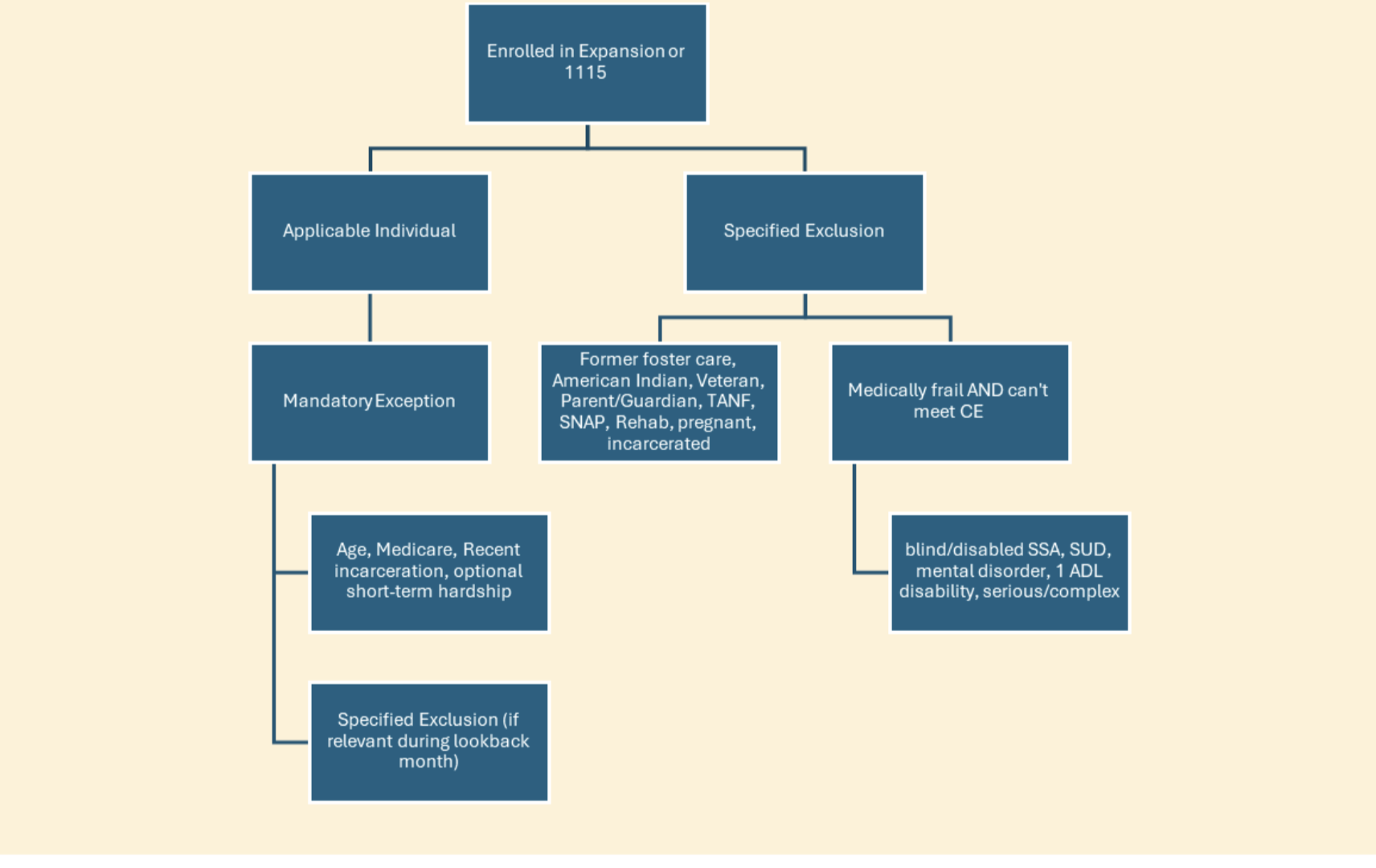
Flowchart of Medicaid eligibility and exemption pathways under Expansion/1115 coverage.
State Good Faith Exemptions
Finally, Congress created a pathway for states to delay implementation of the community engagement requirements altogether. States can apply to CMS and demonstrate that they have made a good faith effort to implement the program. Under the law, these exemptions can last as long as a year, delaying implementation until January 1, 2028. In the rule, however, CMS indicated it expects not to approve any exemptions longer than six months, which would delay implementation only until July 1, 2027.
Our next newsletter will cover how a person actually proves that they are meeting the requirement or qualify for an exclusion or exception.